

Moment of Zen - Super Mar10 Day!
Wahoo!
Rewind to 1981. Arcades were generating billionsof dollars in quarters, and Atari was selling
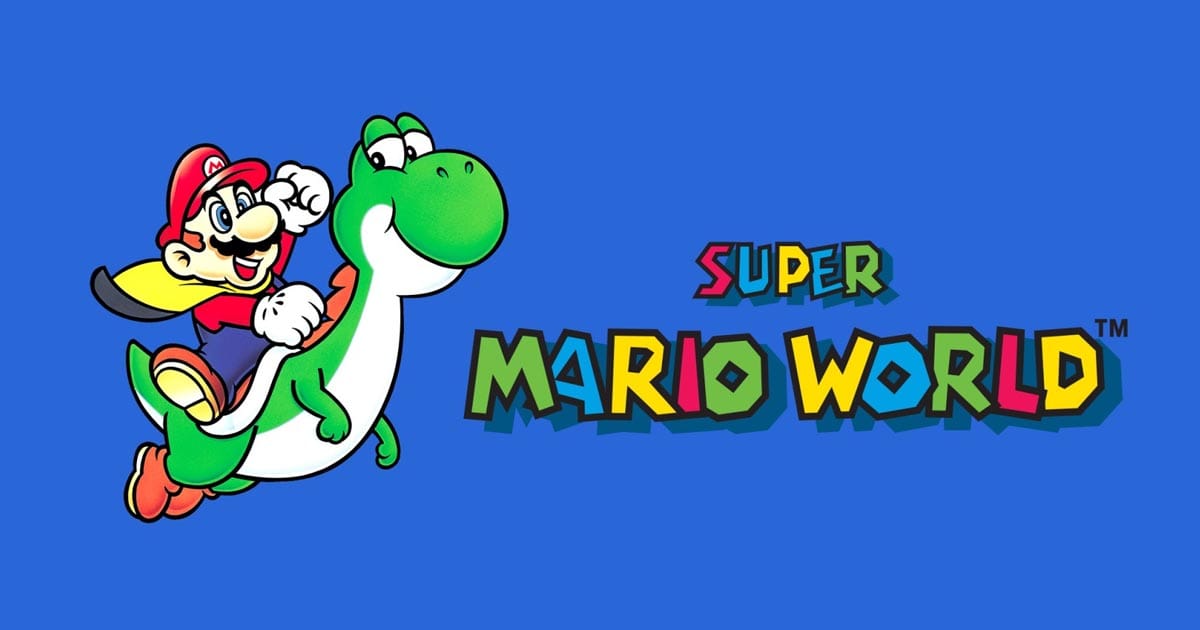
What happens when you combine an eight-year-old's two favorite things; Super Mario, and dinosaurs? Well, he'd probably also want a few Ninja Turtles thrown in for good measure just so you'd be covering the holy trinity. This isn't about turtles - at least not ninja ones. I'm bad at segues. This is a review for Super Mario World on the Super Nintendo Entertainment System.
"I think that inside every adult is the heart of a child. We just gradually convince ourselves that we have to act more like adults."
~Shigeru Miyamoto
By the time Nintendo was appending adjectives to their consoles, young Lynk was already in this for life. I was immersed in video games as a pastime, as a narrative device, as a conduit to escapism, and as a social zamboni. I was eight. Did I mention that already? Sorry, I was brought up by video games so sometimes I get repetitive.
The point is, I was deep into video games and none of them stood higher than Super Mario. Up until that point, at least based on my perspective, each one of Mario's adventures were epic and unique. Super Mario Bros set the bar, and Super Mario Bros 2 introduced us to a whole new world with different mechanics. Super Mario Bros 3 brought us back to the more familiar, but proved there was so much more we could do with the portly red plumber. This isn't a review about those games, but it's important to see the progression. It's important to see that, to the eyes of a dorky child, these games built a realistic and complex world. A world that we were all but guaranteed would always be growing and expanding and changing.
Super Mario World obviously kept that motif.
You almost can't talk about Super Mario World without talking about the launch of the Super Nintendo. My experience, I feel, is oddly unique, and it starts with an infomercial that has nothing to do with Super Mario World.
I've yet to find clips of this on the Internet, but I recall it well enough to paint a pretty decent picture. It was for a game on the original NES, which the Super Nintendo would become a successor of. The game was called The Fantastic Adventures of Dizzy and a pair of adults on the Home Shopping Network were trying to talk it up. They wanted the audience to believe that you didn't need to invest in the Super Nintendo to get next generation graphics and gameplay. They made a big deal about how Dizzy was so cute and well-animated and that he could walk behind objects, adding incalculable amounts of depth to the future of video games. I didn't know who this Dizzy cunt was, but I knew from that moment on that the Super Nintendo was going to change my world. Eight-year-old logic usually can't be contested.
I've yet to play The Fantastic Adventures of Dizzy, but I'm sure I'll get around to it someday.
When you look at the hardware that older consoles were working with and compare them to today's standards, or even standards from ten or twenty years ago, it's incredible to think about how developers juggled the computing resources they had available to them.
The Super Nintendo (popularly known as the SNES), had a 16-bit processor running a mere 3.58 MHz, a megabyte of RAM, and half a megabyte of video RAM. In comparison, a Samsung Galaxy S20 has a 64-bit octa-core processor running at 2.7 GHz + 2.5 GHz + 2.0 GHz with 16 gigabytes of RAM. Modern devices are insane powerhouses in comparison to what we had in living rooms back in the early 90s.
Yet, the SNES was a massive upgrade from the NES, and was designed to impress. If my math is right, the Super Nintendo Entertainment System has 257 times more memory space than the NES. It has 32,768 available colors to choose from, and could display up to 256 on screen at once. The NES only has 54 colors for developers to use, and it could only display three colors on any particular tile or sprite.
Super Mario World was the big launch title for the SNES, and it had to showcase just what the console could do. Nintendo has never been about vanity however, and that's why their games often withstand the test of time and still look great and play great decades later. Sure, they incorporated a lot of neat technical features into Super Mario World, but the fun gameplay always came first.
Of course, having to buy another console, a more expensive console for that matter, didn't sit well with parents. I'll probably cover this more when I start talking about the great console wars of the early 90s in another article. All you need to know for now, is that Nintendo needed to latch onto their audience harder than ever.
In case putting Super Mario on the label didn't make it an immediate sales, they stuck a cape on the man and stuck the man on a dinosaur. My eight-year-old cup runneth over.
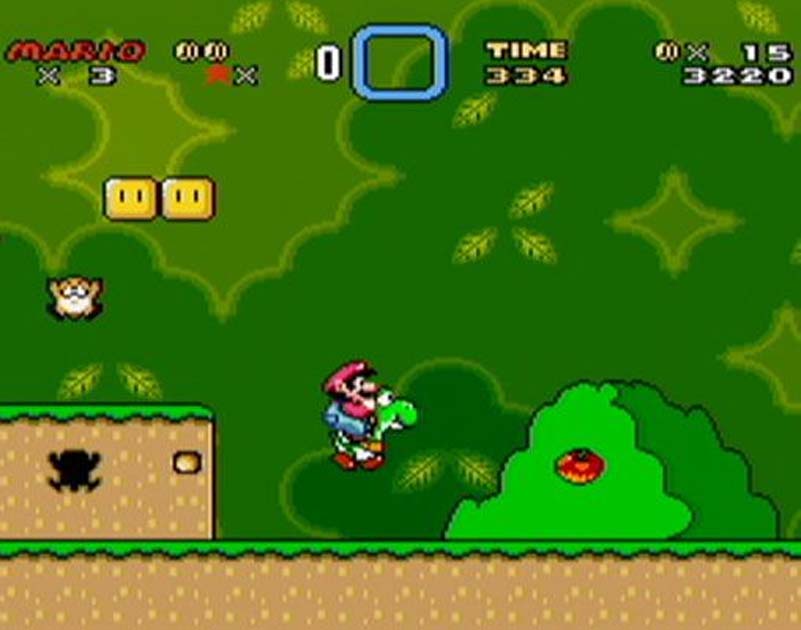
The addition of Yoshi, Mario's bottomless-pit of a dinosaur chum, added a whole new dynamic to the proven system. Sure, Mario still had his range of power-ups - a mushroom makes him grow, a flower makes him throw fireballs, and the newly added feather adds a cape which he can use to fly and attack; but Yoshi wasn't just a power-up. He was your partner. Yoshi was your friend.
You would find Yoshi trapped inside a block like a typical power-up, but he wouldn't change anything about Mario - he'd accompany you if you jumped on his back. Yoshi served as your trusty steed, and served you by eating enemies, strengthening your jump, and helping you make it through tougher spots. Mario wouldn't get hurt while riding Yoshi. If you were riding Yoshi and made contact with an enemy, Yoshi would squeal and bolt away, but Mario would ultimately be unharmed. If you were quick enough, you could jump back on Yoshi's back and guide him to safety.
This made Yoshi feel real. It gave him personality. He protected you, but he was only so strong.
On top of that, Yoshi had his own power-ups as well. Holding different colored shells (from the turtle-esque Koopa Troopers) in his mouth allowed Yoshi to belch fire, stomp the ground, or sprout wings and fly. If Mario was wearing a cape while riding Yoshi, Yoshi would be able to ascend high into the air in a similar fashion as Mario could by himself, although he couldn't sustain flight as long as Mario.
Suddenly, there were exponentially more actions you could pull off, and the game never required you to master them - you just could.
Before I prattle on much longer, let's get to the metrics.
Super Mario World is pure, quintessential Mario. It takes everything from the previous games and improves upon it. You are given the goal to rescue the princess, and you find yourself on a map screen. Whereas previous games simply drive you through one level after another, Super Mario World immediately drops you off at a forked road, and you need to choose a direction.
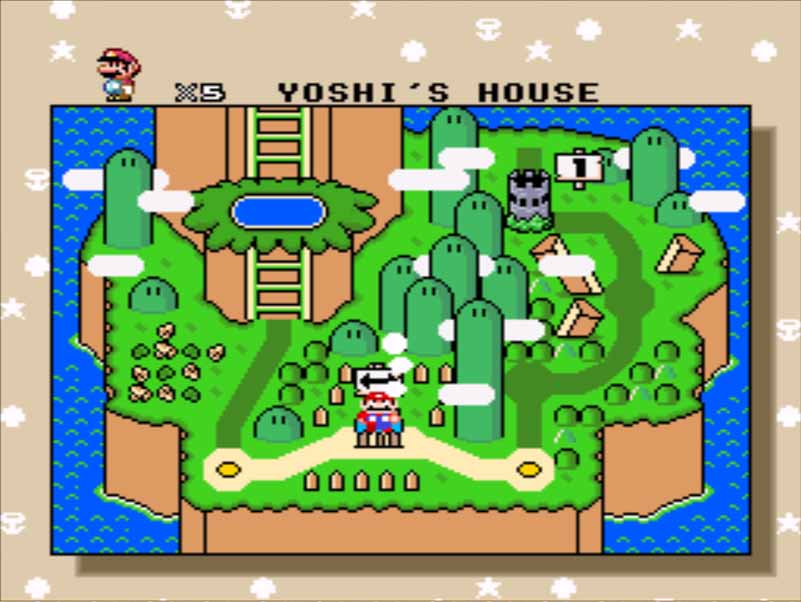
This immediately sets the scope of this game - there will be choices and different paths. The player will be responsible for carving out Mario's adventure. In fact, you can either scour through the entire world and hunt down every secret level exit (there are 96 of them) or you knock on Bowser's front door after trekking through just eight stages.
Once you enter a level, everything will feel very familiar for those who have played a Super Mario game. You typically travel left-to-right, dodging and dispatching baddies, collecting coins, and jumping around until you get to the end.
The controls are tight, and movement feels very natural. Mario's movement is very responsive, even when in the air - the player is always in control and it's easy to lock in a feel for what Mario will do. This is something that I personally feel most game-scrutinizers miss - Nintendo has nailed movement with Mario. Not just in Super Mario World, but ever since Super Mario Bros on the NES, and it's very clear that they put a lot of care and attention into exactly how it feels to propel the portly plumber around. It's still this way with all of the 3D Mario games, and while they get a lot of credit for a great many things, I don't think they get enough credit for movement.
Difficulty ramps gradually as you progress, though the game is very forgiving and offers plenty of lives and power-ups to help you through. There are some stages, and specifically some exits that require a greatly ramped level of technical prowess to overcome, but novice players can usually find another path forward or keep practicing until they can brute force their way through.
Level design is built around discovery mostly; rewarding players for finding secrets or getting to certain areas of a stage with Yoshi or another power-up or item to gain access to new areas. Of course, you could also simply get a running start and fly through many of the courses until you reach the end, ignoring the enemies, pitfalls, and treasures that lie below. Again, it's about choices.
Some stages toss in a unique mechanic (like having enemies and power-ups floating by in bubbles that pop as they run into the player or other objects, or making you ride a raft made out of skulls across a lava river), Some stages are very straightforward and others are tricky labyrinths.
You don't need much narrative for a Mario game. Give him someone or something to save, point in a general direction, and it's enough. Super Mario World does just that with one quick introduction screen before it sets you loose.
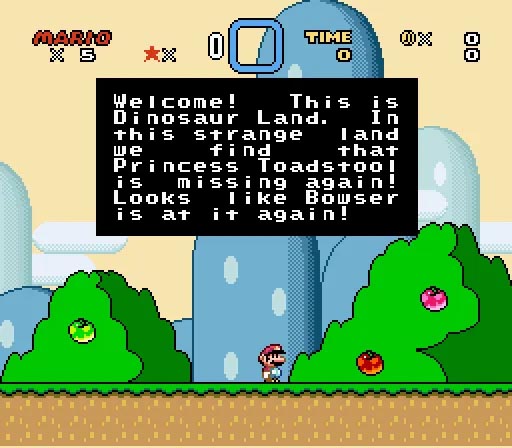
The game grants you a cute little cutscene after you defeat each world's castle, and simply encourages the player to keep going.
It's no Breaking Bad, but nobody is playing a Mario game to see just how Luigi is going to fuck everything up and get the brothers in trouble with the DEA this time around.
Visually, Super Mario World is clean, colorful, and simple. It never tries too hard to look incredible, and that's what helps it withstand the test of time. The SNES had a slew of graphical capabilities that Nintendo subtly put to good use, but never let them overshadow the gameplay itself.
This includes:
Yet, the visuals for Super Mario World never distract from the gameplay. It looks nice, but instead of trying to put you into the game, these advanced capabilities were used subtly.
The sprite work (the characters and enemies) is crisp and the backgrounds set tones without distracting from the game. Animations are simple, and although I feel like walk cycles for Mario and his enemies could have used some more frames to really show the capabilities of the system, going too far would detract from the overall game.
Super Mario World has fun, energetic music that takes advantage of the Super Nintendo's sound chip. Koji Kondo composed a new classic melody that is nearly as iconic as the original Super Mario Bros overworld theme. There are only a few tracks in the game, and most are written around the same melody. For example, a typical stage has this theme:
Subscribe to my newsletter to get the latest updates and news